Christmas Bingo for Family Game Night
Print one card per person from the 30 in the set and put the 40 folded calling cards in a Santa hat. Start with four corners for the youngest, play a line round or two, and finish with blackout. The winner of each round becomes the next caller. The full set is $5 on Lava.top.
Updated · By Pintergrab
Lite is free to download, no sign-up. Pro is sold on Lava.top.
Setting up at the table
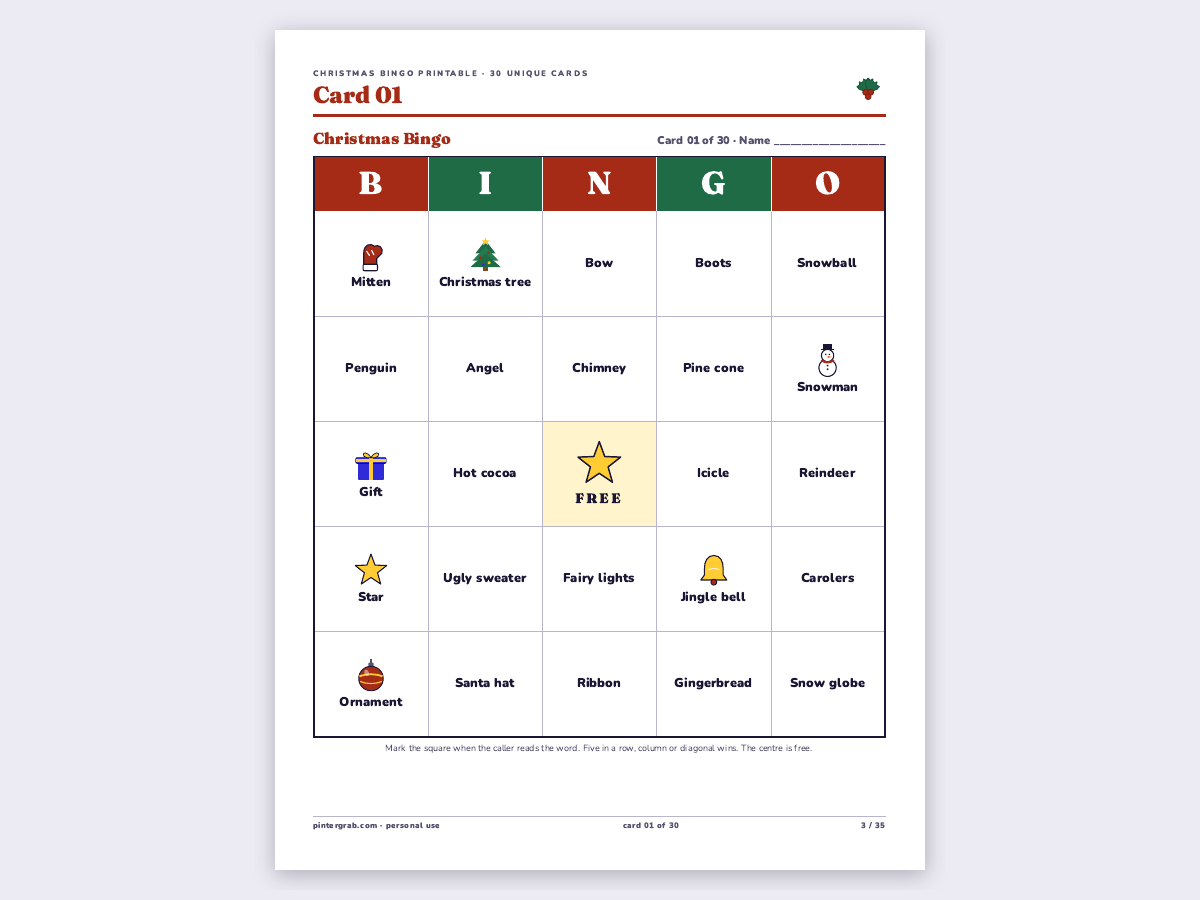
Print one card per person. The set has 30 different cards, so a family of eight takes eight different cards and the rest wait for guests. Print the two calling-card pages once, cut on the dashed lines, fold each card and drop all 40 into a bowl or a Santa hat. Print a tracker for each round.
Use pennies, buttons or mini marshmallows as markers and the cards stay clean for next year. A pencil works for a single game.
An evening in four rounds
- Four corners. The quickest round, and a fair chance for the youngest players.
- Line. Five in a row, column or diagonal, ten to fifteen minutes. Play it twice if the table wants more.
- Picture frame. All 16 squares around the edge, about twenty-five minutes.
- Blackout. Every square. The rules page calls it the long game for the end of the party.
The FREE square in the center counts toward a line and toward blackout. Between rounds, put all the calling cards back into the hat and clear the markers.
Mixed ages at one table
The caller reads each word loudly and shows the card, and ten of the words have small pictures, so a young child can match a word without reading it. Seat a little one next to an older cousin who checks the card with them. Each of the 40 words sits on 13 to 24 of the 30 cards, which keeps most players busy on most calls.
Prizes without a shopping trip
The rules page suggests three: first choice of the cookie plate, caller for the next round, and a candy cane or a paper crown. Passing the caller's job to each winner keeps the game moving and gives the grown-ups a turn to play. Write the winner's name and card number on each round's tracker, and the stack of trackers shows who won what by the end of the night.
In short
For family game night, the Christmas Bingo Printable from Pintergrab gives every relative a different card from a set of 30, each a 5×5 grid of Christmas words with a FREE center. The caller draws from 40 calling cards, reads each word, shows it and ticks it on a tracker, so even a child who cannot read yet can match the word with help from the pictures on ten of the words. The rules page has four rounds that make an evening: four corners, the quick one for little ones; a line, ten to fifteen minutes; picture frame, all 16 edge squares; and blackout, the long game for the end. Markers can be pennies, buttons or mini marshmallows, or a pencil for one game. Prizes can cost nothing: first choice of the cookie plate, caller for the next round, a candy cane or a paper crown. The set is $5 on Lava.top, one payment.
Questions people ask
How do we keep the cards for next year?
Mark squares with pennies, buttons or mini marshmallows instead of a pencil, and the printed cards stay clean. Keep the 30 cards and the cut calling cards in an envelope with the rules page, and print fresh trackers next December.
What happens when two people win at once?
They share the prize, or play the one-word tie-break from the rules page: the caller draws the next word, and the first of the two players to find it on their own card wins the round.
Can we play without a fixed caller?
Yes. Take turns drawing from the bowl: whoever draws reads the word aloud and shows the card, and the person sitting next to the tracker ticks it. Rotating the job also lets every grown-up play a round.
Which round should we start with?
Four corners. It needs only the four corner squares, so it ends quickly and gives the youngest players an early win. Save blackout for last, because it covers every square and uses most of the 40 calling cards.